

A production RAG system can pass every operational check and still fail the only test that matters: telling the truth. Requests complete, latency stays within target, and the generated prose reads confidently while the evidence underneath it is missing, stale, or misread.
This happens because technical availability and semantic correctness are different properties. A vector database can return results even when they are irrelevant. A language model can produce a complete answer from incomplete evidence. A workflow can perform every step successfully while carrying one incorrect value through the entire chain.
Production reliability therefore requires more than uptime monitoring. It requires mechanisms that detect whether the system is retrieving the right evidence, using the current version of that evidence, preserving values across multiple steps, and remaining stable as models and data change.
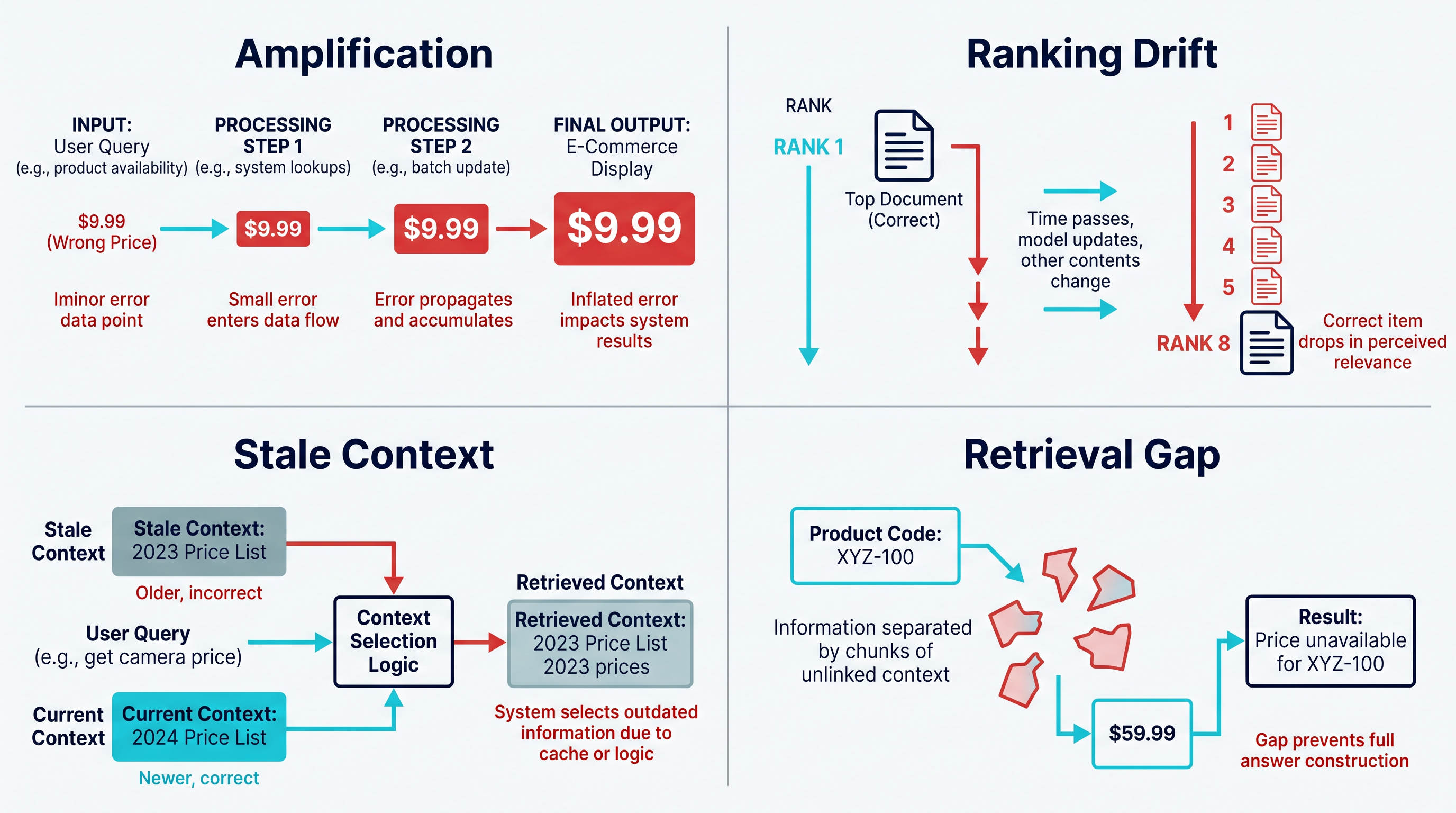
Four failure modes are particularly important: hallucination amplification, ranking drift, stale context, and retrieval gaps. Each can remain invisible until a user notices a bad answer. Each has a different cause and requires a different remedy.
Silent Failure Is a State, Not an Exception
A conventional backend failure is easy to classify. A database connection times out, a request returns 500, or a schema validator rejects malformed input. These events leave clear operational signals.
A semantic failure can satisfy every technical contract:
- The request is valid.
- Retrieval returns five chunks.
- The model produces valid JSON.
- The response passes the API schema.
- Latency remains within the service-level target.
- The final value is incorrect or unsupported.
This is why RAG systems need semantic observability. Logs must capture what was retrieved and generated, evaluation must run continuously, and known questions must be asked proactively rather than waiting for user reports.
Failure Mode 1: Hallucination Amplification
Hallucination amplification occurs when an early error becomes an accepted input to later steps. The error grows because every downstream operation treats the previous output as trusted state.
Consider a multi-step procurement analysis:
- A document extraction step reads a unit price as
15.00instead of150.00. - A calculation step multiplies the wrong price by the purchased quantity.
- A comparison step concludes that the supplier is substantially cheaper than alternatives.
- A final synthesis recommends a purchasing decision based on the incorrect total.
Every later step may be internally consistent. The calculator correctly multiplies the wrong input. The comparison correctly uses the wrong total. The explanation accurately describes the result it received. The original error has become harder to see because it is wrapped in a coherent chain of reasoning.
Preventing the Initial Error
The first line of defense is schema grounding. Before a model queries a structured source, it should receive the exact schema, field definitions, units, and permitted operations. A field named unit_price_net should not be confused with a gross amount, discount, or list price.
For document extraction, the system should retain the source region and confidence for every value. A unit price without a source reference should not enter a calculation.
Arithmetic must be deterministic. The language model may choose which values belong in a formula, but a calculator or typed function should perform the computation.
Protecting Step Boundaries
Intermediate results should be structured rather than passed as free-form prose:
{
  "product_code": "PRD-482",
  "unit_price": 150.00,
  "currency": "EUR",
  "source": "invoice-2026-0148-line-04",
  "confidence": 0.97
}
Every transition can then enforce simple conditions:
- Required fields are present.
- Numeric values have numeric types.
- Currency and units are explicit.
- A source reference exists.
- Confidence meets the threshold for automated processing.
If a condition fails, the workflow should stop or route the item to review. An explicit empty value is safer than an uncertain sentence that later steps may misinterpret as fact.
Runtime Consistency Checks
Before the response is delivered, the values displayed to the user should be compared with the tool outputs used to create them. If SQL returned 150.00 and the final answer states 15.00, the response should be blocked and regenerated.
This check does not prove that the database value is correct. It proves that the language model did not mutate the evidence during generation. That narrower guarantee is still valuable and can be implemented deterministically.
Regeneration must also have a bounded failure path. If the second attempt still conflicts with the verified tool output, the system should stop generating, tell the user that it cannot provide a reliable answer, and attach the trace to a review queue when the request is high impact. Repeated retries only increase cost and can turn a detected inconsistency into a confidently phrased error.
Locating the Original Error
A trace should record the query rewrite, router decision, tool arguments, retrieved rows or chunks, calculations, intermediate state, and final answer. When an error is found, the trace reveals whether the failure originated in extraction, schema interpretation, retrieval, calculation, or generation.
The corrected case should then be added to a golden dataset. Prevention, boundary validation, tracing, and regression testing form a complete defense against amplification.
Failure Mode 2: Ranking Drift
Ranking drift occurs when a query that previously returned the correct evidence near the top begins ranking it lower. No application code needs to change. The system may remain fast and available while retrieval quality declines.
Two causes are common, and they should not be treated as the same problem.
Embedding Space Changes
Changing or fine-tuning an embedding model creates a new vector space. Vectors produced by the old and new models cannot be assumed to be comparable. Mixing them in one index creates inconsistent rankings.
A safe migration requires:
- Preserve the original source text independently of the vector index.
- Create a separate index for the new model.
- Re-embed the entire corpus with one pinned model version and configuration.
- Store the embedding model version as metadata.
- Run the golden retrieval set against the new index.
- Switch traffic atomically through an alias or configuration change.
- Retain the old index temporarily for rollback.
Incrementally replacing vectors inside one live index can leave a partially migrated collection in which rankings have no coherent meaning.
Corpus Growth
Ranking can also degrade when the model remains unchanged but the corpus grows. A product query that once searched 10,000 passages may later compete against hundreds of thousands of new passages with similar terminology.
Re-embedding the same text with the same model does not solve this form of drift. The vectors are not corrupted; the ranking competition has changed.
Diagnosis should ask which query categories degraded:
- If company, supplier, or product filters are missing, the problem may be query understanding or routing.
- If filtering is correct but relevant passages rank poorly, reranking, chunk quality, or candidate depth may be responsible.
- If broad unfiltered searches degrade, index parameters,
top-k, and reranker capacity may need adjustment. - If exact identifiers fail, lexical retrieval may be missing from the path.
Golden datasets must grow with the corpus. A benchmark containing only old products can confirm that historical queries still work while revealing nothing about retrieval quality for newly added information.
Detecting Ranking Drift
Retrieval metrics should be tracked over time rather than only during releases:
- Recall at
k - Mean Reciprocal Rank
- Normalized discounted cumulative gain
- Similarity-score distribution
- Reranker-score distribution
- Rate of low-confidence retrieval
- Correct-source rank by query category
A sudden shift after an embedding migration points toward vector-space inconsistency. A gradual decline correlated with corpus growth suggests competition, filtering, or ranking capacity.
Consider an illustrative corpus-growth incident: Recall@10 for product-price queries falls from 0.91 to 0.74 over three weeks while latency and error rates remain flat. The decline begins after 40,000 new, similarly worded passages enter the index and compete with older product records. Breaking the metric down by query category reveals that exact product codes are affected most; adding metadata filters, increasing candidate depth, and applying a lexical-plus-dense reranker restores Recall@10 to 0.89. The numbers alone do not identify the fix, but they turn a vague complaint about answer quality into a testable retrieval hypothesis.
Failure Mode 3: Stale Context
Stale context means the system answers from an older version of information even though a newer source exists or should exist.
There are two distinct scenarios.
Ingestion Lag
A new price list or invoice has arrived, but it is waiting in a queue, has failed parsing, or has not yet been embedded. The database cannot retrieve data that never became searchable.
The ingestion pipeline should expose a state machine:
received → validating → parsing → embedding → indexing → searchable
Every document needs timestamps, status, retry count, model version, and failure reason. Monitoring should reveal how many documents are waiting at each stage and how long they have remained there.
A system should not claim that its index is current when relevant documents are still pending. For time-sensitive requests, the router may need to check ingestion status or query the structured source directly.
Competing Versions
The newer document may already be indexed while the older version remains available. A generic semantic search can retrieve either one unless freshness is represented explicitly.
Every record should include temporal metadata such as source date, effective period, ingestion time, and version. The retrieval policy can then distinguish among:
- Current-state questions, which should prefer the newest effective record
- Historical questions, which should filter to the requested period
- Comparative questions, which may require several versions
Older data should not always be deleted. Historical analysis depends on it. The correct solution is temporal routing and filtering, not indiscriminate removal.
The final answer should expose the relevant date or period so that users can see which version supports the result.
Failure Mode 4: Retrieval Gaps
A retrieval gap exists when the correct information is present in the source and index but the search path fails to retrieve it. The system still returns something, often a low-scoring but plausible passage.
Retrieval gaps usually fall into three categories.
Broken or Context-Free Chunks
A table may be divided so that the product code is in one chunk and its unit price is in another. A statement such as “the amount increased by 20 percent” may lose the title that identifies which amount and period it describes.
The solution belongs in ingestion:
- Parse documents with layout awareness.
- Keep table headers and rows together.
- Preserve section hierarchy.
- Add contextual headers to independently ambiguous chunks.
- Store source coordinates and parent-child relationships.
No query transformation can reliably recover information that was never stored as a coherent retrievable unit.
Query and Document Terminology Differ
A user may ask for “purchase price” while the document uses “net unit cost.” Embeddings often bridge this gap, but domain terminology and abbreviations can still cause misses.
Query rewriting can expand the request using corpus terminology. The rewritten query should preserve the original entities, date range, and intent while adding controlled synonyms. The transformation itself should be traced and evaluated because an incorrect rewrite can create a new failure.
Exact Identifiers Have Weak Semantics
Product codes, invoice numbers, and document IDs may not have meaningful semantic neighbors. Dense retrieval can overlook them even when the exact string exists in the corpus.
Hybrid search adds a lexical channel. BM25 retrieves exact tokens while dense retrieval captures explanatory content. Fusion and reranking combine the two candidate sets.
Critical structured values should not be left to text retrieval at all. If validated unit prices and totals are stored in relational tables, the router should send exact numeric questions to SQL.
Detecting Retrieval Gaps
Low-score and empty retrieval events should be logged, but they are not sufficient. Some systems always return k results even when none are useful.
Detection should combine:
- Context recall on a golden retrieval set
- Distribution of top similarity and reranker scores
- Query categories with frequent abstention
- User reformulation behavior
- Manual review of low-confidence results
- Verification that the expected chunk exists in the index
Diagnosis should follow the evidence. If the expected chunk is malformed, fix ingestion. If it is coherent but terminology differs, improve query transformation. If an exact code is missed, strengthen lexical retrieval. Applying the same remedy to every gap creates new regressions.
Trace-Based Semantic Observability
Traditional logs often record only the request, response code, and latency. A RAG trace must capture the semantic path:
Original query
→ rewritten query
→ routing decision
→ metadata filters
→ retrieved candidates and scores
→ reranked context
→ prompt
→ tool results and calculations
→ generated answer
→ citations
→ token, cost, and latency data
This trace allows an incident to be replayed and classified. Without it, “the answer was wrong” becomes a search across unrelated service logs and missing model state.
LLM-focused observability platforms such as LangSmith and Langfuse provide practical starting points for capturing nested retrieval, model, and tool spans. The platform is less important than preserving stable trace structure, version metadata, inputs, outputs, scores, and links back to the originating request.
Tracing should respect access controls and data-retention policies. Sensitive source text may need redaction or controlled storage, while identifiers and scores remain available for diagnosis.
Match Observability to Risk and Scale
Not every RAG application needs shadow traffic, continuous model-based evaluation, and a large golden dataset on day one. A low-volume, low-risk internal assistant may start with structured traces, a small golden set, deterministic checks, and manual review of failures. The full stack becomes easier to justify as traffic, change frequency, regulatory exposure, or the cost of a wrong answer increases; sampling and risk-based routing keep evaluation spend proportional to the value it protects.
A Four-Layer Production Dashboard
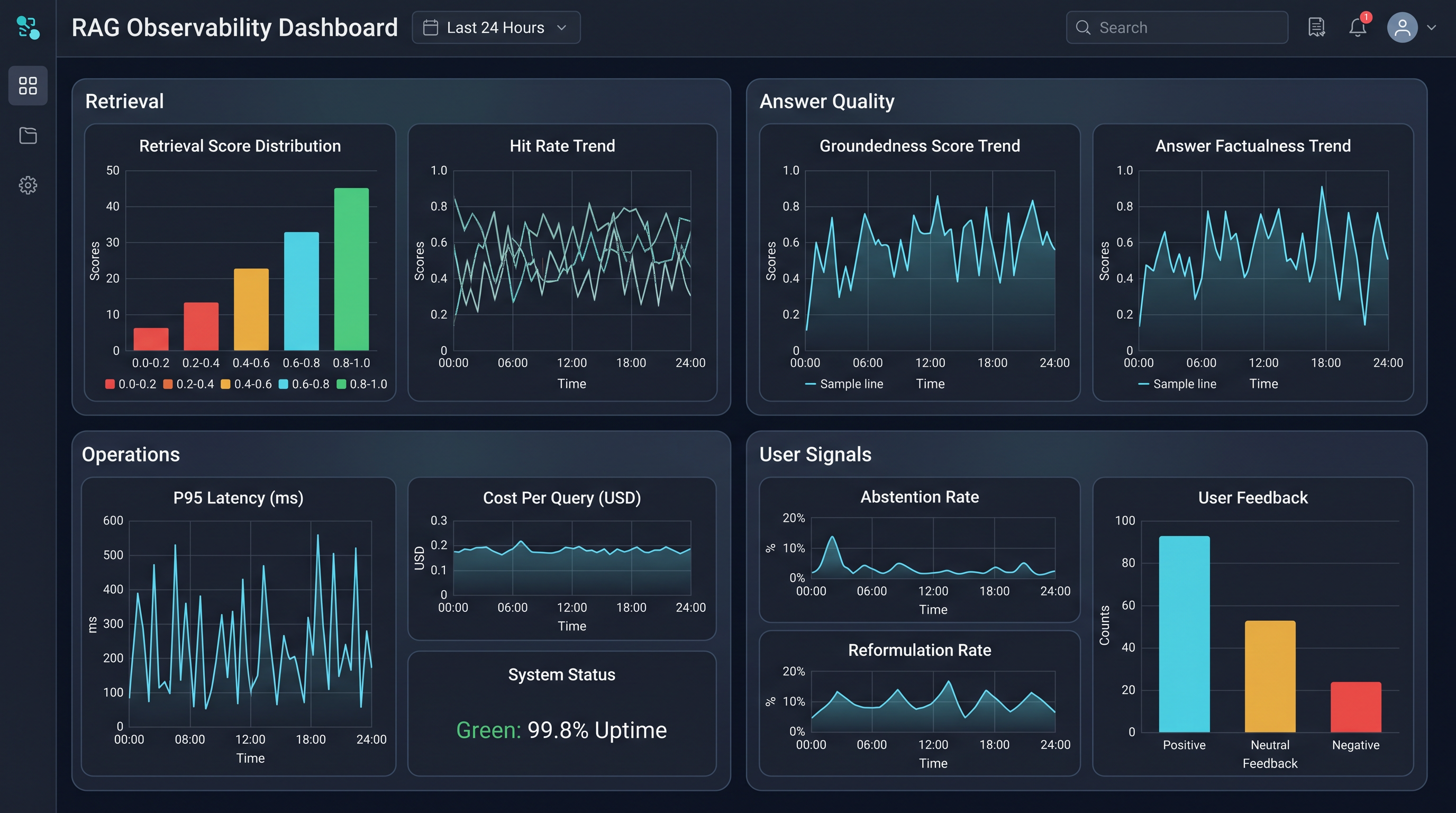
Retrieval Health
Monitor empty retrieval rate, low-confidence rate, score distributions, correct-source rank for synthetic or golden test queries, index size, ingestion lag, and filter usage. Trends matter more than isolated values.
Answer Quality
Sample production traffic for groundedness and answer relevancy. Track citation coverage, verified citation support, abstention rate, schema-validation failures, and runtime consistency-check failures. Ragas, DeepEval, and Arize Phoenix provide implementations for metrics such as faithfulness or groundedness, response relevancy, and retrieval relevance. Citation coverage can remain a deterministic metric: the share of factual claims or answer segments linked to a valid source, with citation support checked separately against the cited text.
An extremely low abstention rate may indicate that the model answers even when evidence is missing. An extremely high rate may indicate retrieval degradation.
Operational Health
Track P50, P95, and P99 latency by stage, not only end to end. Retrieval, reranking, model generation, and tools should have separate spans. Monitor tokens per request, cost per route, timeouts, retries, and queue depth.
User Signals
Explicit ratings are useful but sparse. Implicit behavior can reveal silent failures:
- The user repeats the same question with different wording.
- A session ends immediately after an answer.
- A response is regenerated several times.
- One query category receives disproportionate negative feedback.
Reformulation within a short window is especially valuable because it often indicates that the first answer did not satisfy the request.
Synthetic and Golden Queries as a Semantic Health Check
Synthetic and golden test queries are a small set of known questions run against production on a schedule. They act as an application-level health check. They are sometimes called semantic canaries, but they are scheduled probes, not the same mechanism as a canary release that gradually shifts live user traffic to a candidate version.
The test set should include:
- Exact product-code retrieval
- Current and historical price lookup
- Multi-document questions
- Questions requiring abstention
- Queries for recently added documents
- Critical calculations with known outputs
The system should compare retrieved sources, structured outputs, and final answers with expected values. A failure can detect an upstream model change, index problem, stale ingestion pipeline, or prompt regression before ordinary users report it.
Queries should be versioned and tagged so that failures identify the affected capability rather than producing one undifferentiated alert.
Shadow Deployments and Canary Releases
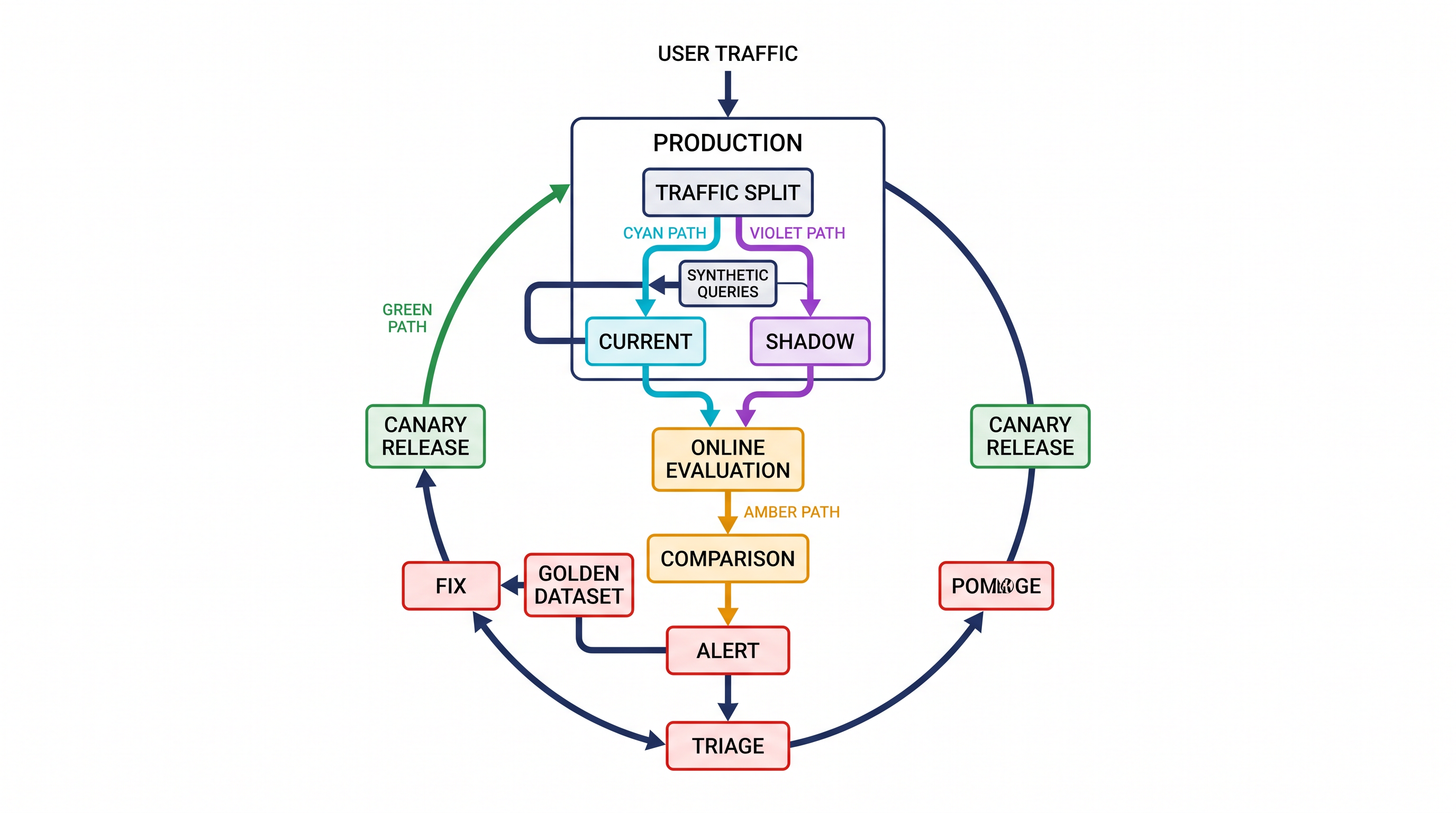
A new prompt, model, chunking strategy, or index can receive a copy of production traffic without returning its answers to users. The current and candidate systems are then compared on the same requests.
Shadow evaluation should examine:
- Route differences
- Retrieved-source overlap
- Ranking changes
- Structured-value agreement
- Faithfulness and relevancy
- Latency and cost
If results remain within accepted thresholds, traffic can move gradually through stages such as 5 percent, 25 percent, and full deployment. This staged exposure is a canary release: unlike the scheduled synthetic queries above, it evaluates a candidate with a controlled share of live traffic. Rollback should remain possible until the new version is stable.
Shadow traffic is particularly valuable for silent failures because test datasets cannot represent every production query pattern.
Continuous Online Evaluation
Evaluating every production response with a second model may be too expensive. Sampling can target the highest-value traffic:
- A random baseline sample
- Low-confidence retrievals
- Responses with negative feedback
- High-value calculations
- Newly introduced query categories
- Requests served by a new model or index version
The focus should be on distributions and trends. A single low groundedness score may be noise. A sustained decline in one route or product category indicates a real problem.
Language-model judges should be calibrated against human annotations. Exact numeric answers and tool consistency should use deterministic checks wherever possible.
Alerting on Changes, Not Only Thresholds
Static thresholds are useful, but semantic systems can degrade gradually while remaining above them. Alerts should also detect deviations from recent baselines.
Examples include:
- Groundedness falls materially below its seven-day average.
- The median top retrieval score shifts after an index update.
- Reformulation rate increases for product-price queries.
- Ingestion time rises while new documents accumulate.
- Cost per query changes after a prompt or
top-kupdate. - A model version appears in an index where it does not belong.
Alerts should include route, model version, index version, and representative trace IDs so that investigation can begin immediately.
Closing the Incident Loop
Observability creates value only when incidents improve the system permanently. Every confirmed semantic failure should follow a lifecycle:
- Capture the complete trace.
- Classify the failing layer.
- Verify the correct source and answer.
- Implement the smallest targeted fix.
- Add the case to the golden dataset.
- Test the fix against other categories for regressions.
- Deploy through a controlled rollout.
- Monitor the affected metric after release.
This process connects production monitoring with offline evaluation. The golden dataset becomes a record of failures the system is no longer allowed to repeat.
Reliability Beyond Uptime
Hallucination amplification, ranking drift, stale context, and retrieval gaps share one property: they can produce convincing responses without breaking the API. Their causes, however, are different. Amplification requires protected step boundaries. Ranking drift requires versioned indexes and continuous ranking metrics. Staleness requires temporal metadata and ingestion visibility. Retrieval gaps require diagnosis across parsing, query understanding, and search methods.
Reliable RAG systems make those distinctions visible. They trace semantic state, run synthetic and golden queries, compare candidate versions in shadow mode, evaluate sampled traffic, and learn from user behavior. Most importantly, they convert every confirmed failure into a regression test.
These controls are not free. They add storage, evaluator spend, operational complexity, and the risk of false positives or alert fatigue. The goal is not maximum observability everywhere, but enough well-calibrated evidence to match the application's failure cost; alerts that never change an engineering decision should be removed or redesigned.
An API health check can prove that a system is responding. Semantic observability is what proves that it is still answering correctly.